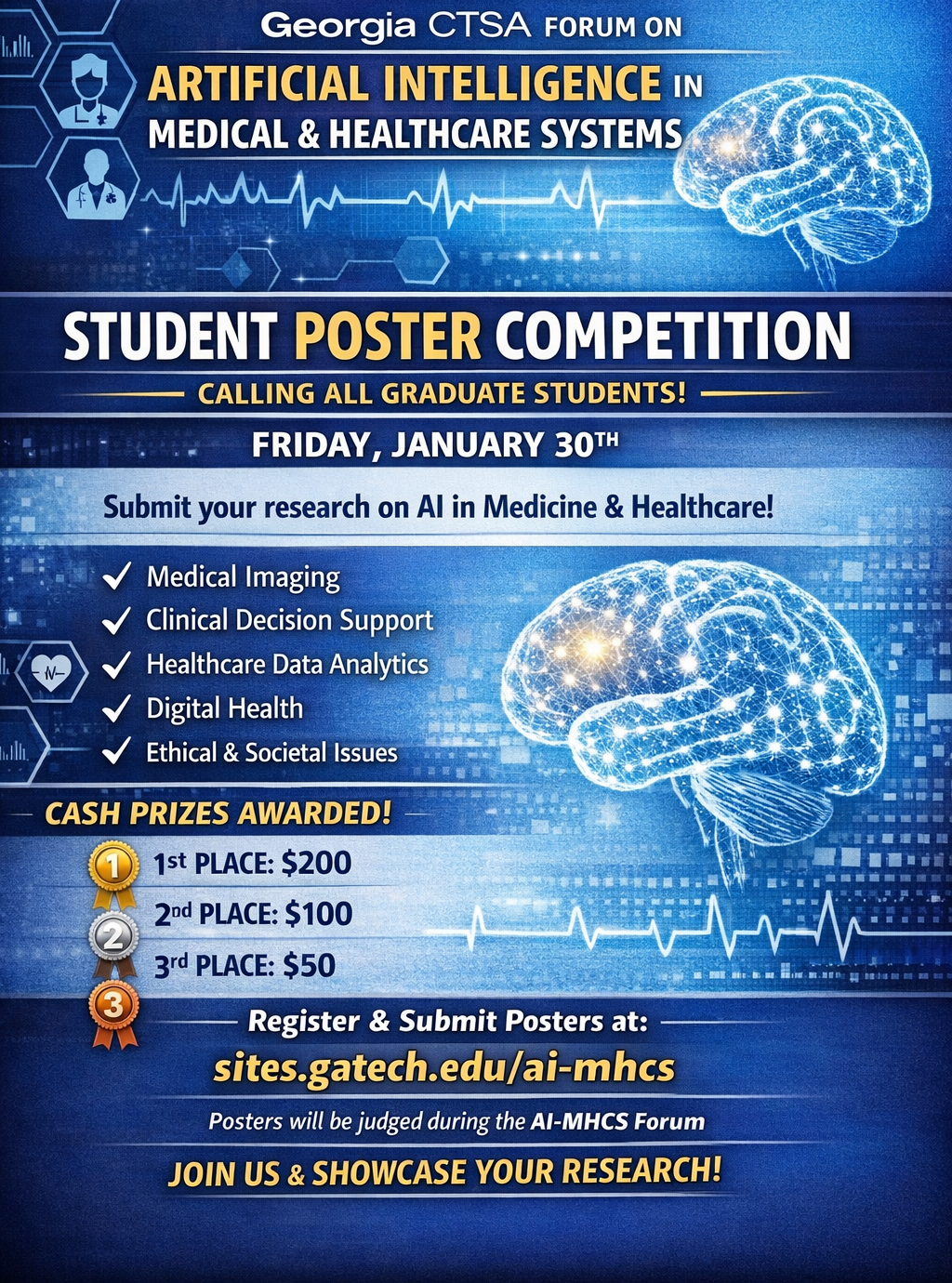
Friday, January 30, 2026, 8:00 am – 4:00 pm EST
ISyE Main Building Atrium, Georgia Tech
Join us for Artificial Intelligence in Medical and Health Care Systems on Friday, January 30, 2026, from 8:00 AM to 4:00 PM EST at the ISyE Main Building Atrium, Georgia Tech. This full-day event will feature two keynote speakers, seven technical presentations, and poster sessions, including a voluntary Best Student Poster Competition. Registration for the conference and poster session will open at the beginning of January, with a fee of $30 per person. The registration will cover breakfast, coffee during the breaks, lunch, and parking validation (please indicate the need for parking validation when registering).
Don’t miss this opportunity to explore cutting-edge AI applications in Medical and Health Care Systems.

Program
| Time | Session | Chaired by |
|---|---|---|
| 08:00 – 08:50 | Registration & Breakfast | |
| 08:50 – 09:00 | Opening: John Hanfelt (Emory; BERD), Jing Li (Georgia Tech; ISyE, CHHS) | Xiaoming Huo (GT) |
| 09:00 – 09:40 | Keynote Presentation: Professor Hongtu Zhu (UNC) | |
| 09:40 – 10:05 | Talk 1: Professor Omer T. Inan (Georgia Tech) | |
| 10:05 – 10:30 | Talk 2: Professor Muhammed Idris (Morehouse School of Medicine) | |
| 10:30 – 11:15 | Poster Session 1 & Morning Coffee | |
| 11:15 – 11:40 | Talk 3: Director Vivian Singletary (TaskForce.org) | Arthi V. Rao (GT) |
| 11:40 – 12:05 | Talk 4: Professor Ying Guo (Emory) | |
| 12:05 – 1:10 | Networking Lunch | |
| 1:10 – 1:35 | Talk 5: Professor Nicoleta Serban (Georgia Tech) | Shihao Yang (Georgia Tech) |
| 1:35 – 2:00 | Talk 6: Professor Xiao Hu (Emory) | |
| 2:00 – 2:25 | Talk 7: Professor Chao Huang (UGA) | |
| 2:25 – 3:10 | Poster Session 2 & Afternoon Refreshments | |
| 3:10 – 3:55 | Panel on AI in Medical and Health Care Systems | Moderated by Raphiel Murden (Emory) |
| 3:55 – 4:00 | Closing Remarks | |
| 4:00 | Workshop Concludes |
Presentation Information
Speaker: Dr. Hongtu Zhu (UNC)
Title: Causal Generalist Medical AI
Abstract: The rapid evolution of flexible and reusable artificial intelligence (AI) models is reshaping modern medical science. In this talk, I introduce Causal Generalist Medical AI (Causal GMAI)—a new paradigm that integrates causal inference with generalist AI models to enhance interpretability, robustness, and generalizability in medical decision-making. Causal GMAI leverages self-supervised, semi-supervised, and supervised learning across diverse multimodal data sources, including medical imaging, electronic health records, clinical trials, laboratory measurements, genomics, knowledge graphs, and clinical text. This unified framework enables a single model to perform a broad range of clinical and translational tasks with minimal task-specific supervision. By explicitly incorporating causal reasoning, Causal GMAI moves beyond purely predictive modeling to infer underlying causal mechanisms. This capability improves diagnostic accuracy, supports more reliable treatment recommendations, and advances personalized and precision medicine. The talk will highlight the methodological foundations, illustrative applications, and future opportunities for building trustworthy, clinically actionable AI systems.
Speaker: Dr. Chao Huang (UGA)
Title: AD-GPT: Large Language Model-based information retrieval for Alzheimer’s Disease
Abstract: Alzheimer’s disease (AD) research produces extensive genomic and clinical data, yet general large language models (LLMs) often generate inaccurate or superficial outputs. We introduce AD-GPT, a domain-specific framework for reliable information retrieval and synthesis of AD-related knowledge. We integrated cis-eQTL and sQTL data across 13 brain regions from GTEx, genomic location information from NCBI, and gene function annotations from OMIM, alongside about 200,000 AD-related academic publications from NCBI’s PubMed. A retrieval-augmented generation workflow, combining a BERT-based classifier with fine-tuned Llama models, was developed to support three tasks: genetic information retrieval, association study information retrieval, and other general information related to AD. AD-GPT outperformed state-of-the-art LLMs in precision and response relevance. Task-specific database partitioning enhanced relevance, and the stacked design ensured robust query routing. AD-GPT harmonizes curated genomic databases with biomedical literature, offering a scalable and accurate informatics tool to advance AD research and healthcare support.
Speaker: Dr. Omer T. Inan (Georgia Tech)
Title: Machine-Learning Enabled Wearable Sensing of Cardiopulmonary Health Parameters
Abstract: Recent advances in digital health technologies are enabling biomedical researchers to reframe health optimization and disease treatment in a patient-specific, personalized manner. This talk will focus on my group’s research on cardiopulmonary sensing and analytics. Our group has extensively studied the timings and characteristics of cardiogenic vibration signals such as the ballistocardiogram and seismocardiogram, and applied these signals for quantifying filling pressures and volume status in the context of heart failure (volume overload) and hemorrhage (volume depletion). We envision that these technologies can all contribute to improving patient care with lower cost and better outcomes.
Speaker: Dr. Xiao Hu (Emory)
Title: A Unified Approach for Continuous Monitoring of Human Health and Diseases from Intensive Care Unit to Home with Physiological Foundation Models (UNIPHY+)
Abstract: Physiological sensing is becoming ubiquitous with wearable devices. Signals such as photoplethysmogram (PPG) and electrocardiogram (ECG) have the potential to provide low-cost, user-friendly solutions for monitoring human health and disease states across care settings. To realize such a potential, different algorithm paradigms are needed, as traditional approaches are error-prone, as evidenced in problems such as alarm fatigue in the current ICU patient monitoring practice. Transformer-based foundation models pretrained with millions of hours of physiological signals have been developed by us and others. These foundation models learn powerful representations of physiological signals that can be fine-tuned for many downstream tasks and have shown state-of-the-art performance in some basic physiological measurement tasks. However, more complex use cases typically require integration of information from a longer temporal window than what a Transformer could efficiently handle, as well as from data of other modalities. With this insight, we present UNIPHY+, a unified physiological foundation model (physioFM) framework that combines the power of physioFM for feature extraction locally and state-space models for integrating local features from an extended temporal window and ingesting additional contextual variables. In this talk, we will share and discuss results from using a single PPG signal to continuously estimate lab test results and blood pressure as well as predicting acute events such as cardiac arrest and sepsis.
Speaker: Dr. Muhammed Idris (Morehouse School of Medicine)
Title: Designing Trustworthy AutoML for Heart Failure Readmission Risk Using Local Context
Abstract: Artificial intelligence and machine learning (AI/ML) methods hold significant promise for clinical risk prediction, yet their impact in real-world care settings remains limited. Despite strong predictive performance in retrospective evaluations, many models fail to achieve clinical applicability due to challenges in reliability, interpretability, and integration into existing workflows. In this talk, I will present our work on designing trustworthy AutoML pipelines that integrate local context (including domain expertise and nonmedical drivers of health) to build more practical and trustworthy heart failure risk prediction models. This work highlights how designing clinical AI/ML systems with local context in mind can help bridge the gap between promising algorithms and real clinical impact.
Speaker: Dr. Ying Guo (Emory)
Title: A Statistical AI Framework for Learning Directed Brain Connectomes from Neuroimaging Data
Abstract: In recent years, connectome-based research has become a central focus in neuroscience, offering essential insights into brain organization and advancing predictive modeling of cognitive, behavioral, and mental health outcomes. While most existing approaches focus on undirected brain connectivity, they overlook the directionality and causal influences between brain regions. To address this limitation, we propose a statistical AI framework for learning directed brain connectomes from neuroimaging data. Our approach integrates principled statistical modeling with deep learning to infer sparse, interpretable directed connectivity graphs that characterize latent causal interactions across the brain. At the same time, the framework learns low-dimensional graph embeddings optimized for downstream prediction tasks, including demographic attributes and clinical phenotypes. The proposed method uncovers whole-brain directed connectivity patterns and reveals novel subpopulation-specific connectomic differences, highlighting its potential to advance both mechanistic understanding and predictive modeling in neuroscience.
Speaker: Director Vivian Singletary (TaskForce.org)
Title: The Emergence of AI in Public Health
Abstract: Artificial intelligence holds significant promise for addressing population health challenges, yet its adoption in public health practice remains limited. This presentation explores AI applications at the intersection of public health and healthcare delivery, examining how predictive analytics and machine learning can enhance disease surveillance and community health interventions. We discuss key barriers to adoption, including infrastructure limitations and workforce capacity gaps. Through use cases such as AI algorithms for early detection of hearing issues in newborns and public health efforts to develop predictive modeling for disease outbreaks, we demonstrate current real-world applications. Finally, we argue that AI literacy training for public health professionals is essential to accelerate adoption and ensure that these technologies effectively support population health goals.
Speaker: Professor Nicoleta Serban (Georgia Tech)
Title: Health Systems & AI: Integrated Research in the School of Industrial and Systems Engineering
Organizing committee
- John Hanfelt (Emory)
- Xiaoming Huo (Georgia Institute of Technology)
- Pinar Keskinocak (Georgia Institute of Technology)
- Mohamed Mubasher (Morehouse College)
- Raphiel Murden (Emory)
- Aparajita Sur (Emory)
- Allan David Tate (University of Georgia)
- Monike Welch (Georgia Institute of Technology)
- Stephanie Nicole Wright (Emory)
- Julia Wrobel (Emory)
Parking
Visitor Area 3: Student Center Deck (W02). See alternate instructions. Click Southwest; then choose “Visitor Area 3: Student Center Deck (W02)”; $15/day. Parking will be validated. Notify the parking need during registration.
Supported by
Biostatistics, Epidemiology, and Research Design (BERD) and The Center for Health and Humanitarian Systems at Georgia Tech
ASA Georgia Chapter is proud to sponsor the best student poster winners in the poster competition.